A compelling, life-saving story
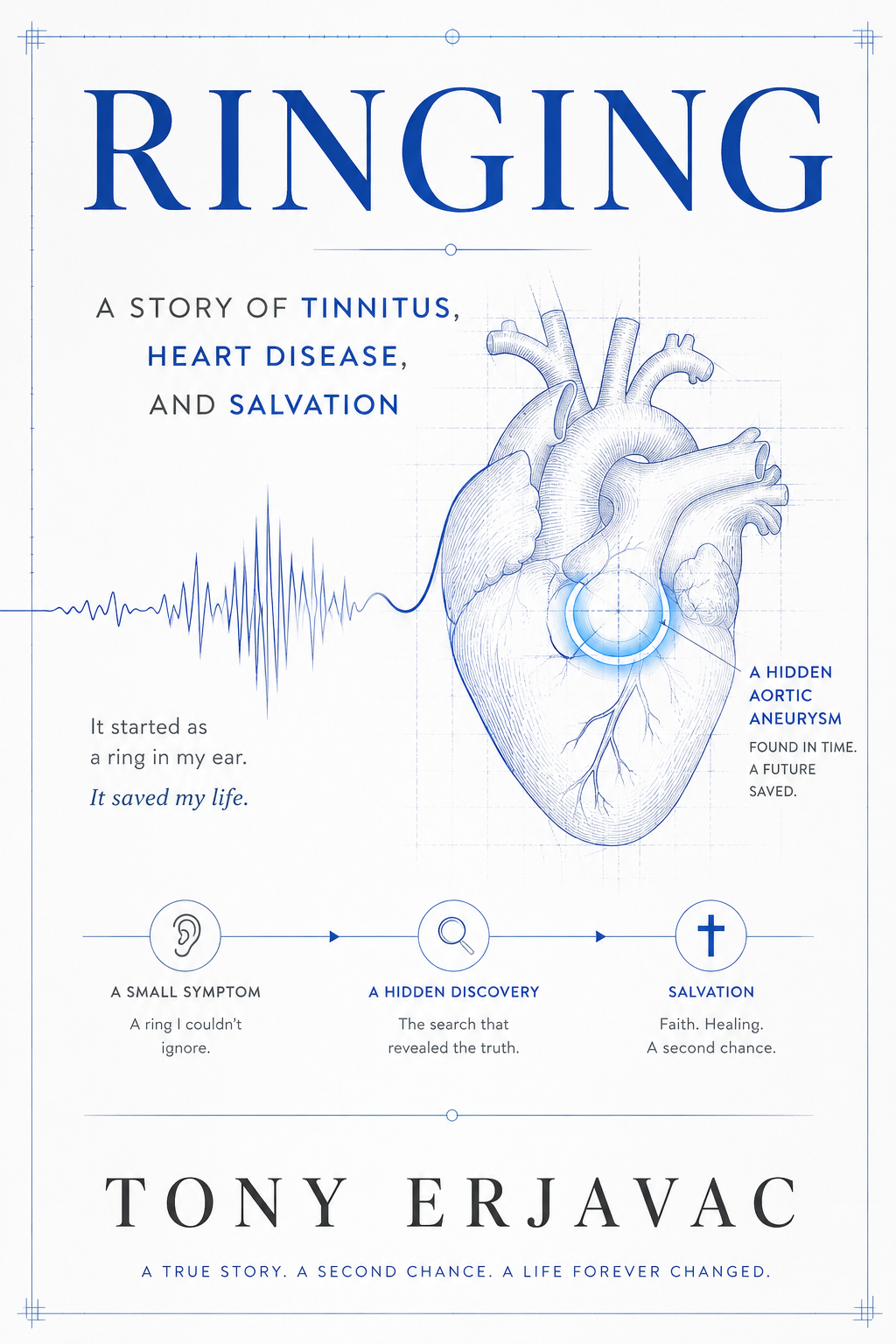
What began as a faint ringing in the ear became the first clue in a chain of discoveries that revealed a hidden, life‑threatening aortic aneurysm. Ringing is the true story of how one unexpected symptom led to a diagnosis that should have come years earlier — and how a single doctor’s thoroughness changed everything.
This book follows the journey from confusion to clarity: the tinnitus that didn’t fit, the thyroid nodules that appeared out of nowhere, the endocrinologist who looked at every system, the tests that finally told the truth, and the open‑heart surgery that delivered a second chance. It’s a memoir of fear, resilience, and recovery — but also a guide for anyone who wants to understand the tests that save lives before symptoms appear.
Part personal story, part patient‑advocacy manual, Ringing shows readers how to navigate a fragmented healthcare system, how to ask the right questions, and how to take charge of their own heart health. It’s a book for anyone over 45, anyone caring for aging parents, and anyone who has ever wondered whether their doctor is seeing the whole picture.
A small symptom revealed a hidden danger. A hidden danger revealed a path to salvation. This book shows how it happened — and how it can happen for others.
Healthcare Articles & Insights
A curated collection of short essays written before and after open‑heart surgery — blending lived experience, systems thinking, and practical guidance for navigating modern healthcare.
Quick reads to help you navigate healthcare
-
In other articles I’ve examined how organizations hide their failures, normalize drift, and mistake correction for capability. Now let’s consider an application, healthcare.
One day, the most complex system I ever had to diagnose wasn't an organization or a process.
It was me.
As a patient, to the healthcare system, you’re an outsider. Most of us don't speak the language and can't independently verify the data. We're dependent on specialists who focus on one system at a time: cardiology, imaging, surgery, but not the system as a whole. The patient is the only one who experiences the full system, but is also the least equipped to decipher it.
I learned that for years, I had an asymptomatic condition. The system was degrading beneath the surface, but nothing in the routine testing flagged it. Annual physicals checked standard markers but didn't surface the problem. Healthcare, like many other systems, is designed to respond to symptoms, not to search for conditions below the surface.
The drift was invisible because the system wasn't designed to detect it.
I lived inside that false security for years. Not because I was ignoring my health, but because the monitoring infrastructure: the annual labs, the routine screenings, the standard-of-care protocols, wasn’t designed to find what was actually wrong. The system was glossing over problems and giving me a clean bill of health.
This isn't anecdotal. A 2025 study published in JACC: Advances by researchers at Mount Sinai evaluated 465 patients under 65 after suffering their first heart attack. Forty-five percent would not have been flagged for preventive therapy under current guidelines. A newer screening model performed even worse, missing 61 percent. The system didn’t fail because it was broken. It failed because it was functioning exactly as designed.
Then one day, the data finally spoke. A test revealed what years of routine monitoring had missed; not because new information was suddenly available, but because someone finally looked where the system wasn't designed to look.
On May 15, I go in for open-heart surgery.
This is where the Health series begins. The systems we depend on for our health operate under the same principles as every other complex system: incomplete information, hidden drift, latent failure modes, and the persistent illusion of stability.
The difference is the stakes. How many others may right now have undiagnosed conditions? There are ways to tell.
This is a case study in how Root Cause Thinking can expose weaknesses and find correctable causes in the system designed to protect our most critical assets: ourselves.
-
As I prepared for heart surgery, the hardest part wasn’t getting ready for a six‑hour operation. It was getting the individual experts around me to work as a team.
Seven weeks out, a cracked tooth needed extraction before surgery. Multiple providers were involved: dentist, endodontist, oral surgeon, cardiologist, and ultimately my thoracic surgeon. I moved fast. The system didn’t.
I hand‑carried the authorization from the oral surgeon to my cardiologist. The cardiologist sent their authorization the next day. Nothing happened.
When I followed up, each office insisted they had “done their part.” The cardiologist sent the authorization on their own form. The oral surgeon received the cardiologist’s form but was waiting to receive the specific form they’d sent, not the cardiologist’s form. The cardiologist believed the job was complete while the oral surgeon’s office patiently waited for a response that would never come.
No one owned the handoff. No one checked for understanding. No one looked at the process end‑to‑end.
Three weeks passed to accomplish something my thoracic surgeon said could be done the day before surgery if necessary.
Had I not intervened, the process would have stalled indefinitely. Not because anyone was negligent, but because each group operated independently, with its own procedures, its own assumptions, and no shared model for coordination.
Here’s the hidden truth of healthcare: we don’t have a healthcare system — we have a collection of independent organizations that occasionally exchange information.
And when the teams don’t line up, the patient falls into the gap.
This isn’t unique to medicine. Any organization can fail at the interfaces. Anywhere a handoff exists, expectations can misalign. Anywhere a handoff exists, failure can hide. And the more specialized the work becomes, the more fragile the integration.
A job isn’t done when you send the information. A job is done when the receiver confirms they understood the message.
That’s why we use checksums. To ensure accuracy. That’s why radio operators reply “Roger.” To ensure the sender knows the receiver got the message.
Systems work when communication is designed, not assumed. They fail when every group optimizes for its own workflow instead of the outcome.
This is why Root Cause Thinking matters. It exposes the conditions that make these failures possible, and correctable. It forces us to look at the structure, not the people. It shifts responsibility from individuals to the process. And it reminds us that the most important person in the process is the one with the least visibility: the patient, customer, or user.
If this can happen during something as critical as preparing for heart surgery, imagine how often it happens when the stakes aren’t obvious.
Integration isn’t a luxury. It’s the system’s greatest source of failure.
-
When you need surgery, you assume the hard part is the procedure. It isn’t.
The real challenge is the pre‑op coordination across a dozen disconnected support processes, and it extends farther than you might expect: family doctor, cardiologist, dentist, surgical team, hospital, authorizations, labs, imaging, and scheduling.
Every one of these groups needs something from the others. Almost none of them easily communicate.
HIPAA restrictions, incompatible systems, file‑size limits, portal silos, and, unbelievably, fax machines create a communication environment where information moves slower than the patient’s condition progresses.
So, how do you facilitate success?
The Patient Becomes the Program Manager
To get the best result and facilitate the process, you end up collecting documents, forwarding results, chasing signatures, confirming authorizations, and verifying that each office has what it needs before the next step can happen. Not because anyone is negligent, but because the system isn’t designed to coordinate itself. No one tracks how long something sits waiting for action.
At one point, I scanned and emailed a dental clearance form directly to the surgeon’s office because the two systems couldn’t electronically exchange a simple PDF. The protocol was fax which meant multiple handoffs and delays. That single bottleneck could have postponed the entire procedure.
This isn’t a one‑off story. It’s a structural pattern.
Where the System Breaks Down
Healthcare has world‑class clinical capability wrapped in support processes that operate like separate companies. Each group does its part well, but the handoffs — the connective tissue — are where the breakdowns occur.
And when the system can’t coordinate itself, the risk shifts to the patient.
The failure isn’t clinical. It’s structural.
The only stakeholder affected by the entire system is the patient. And just like managing any complex process, Root Cause Thinking applies here, too.
Until healthcare measures and manages the support processes around care — not just the care itself — patients will continue to carry the coordination load that the system should be handling, or suffer the consequences when disruptions occur.
Take charge of your health. It seems obvious, but like any process. The disconnects are hidden along with the problems.
-
Healthcare is full of brilliant people doing world‑class work. My maxillofacial surgeon removed a cracked tooth flawlessly.
The clinical care was exceptional, but the administrative process around that care? That was a different story.
And this is where healthcare looks a lot like every other industry.
Core Competency Excellence, Support‑Process Chaos
In aerospace, the engines are perfect, but the recordkeeping is a mess.
In universities, the research is cutting‑edge, but the advising process is unmeasured.
In manufacturing, the product is flawless, but the payroll process is duct‑taped together.
Healthcare is no different.
The surgeon’s work was precise. The office’s administrative workflow was not.
Authorizations stalled. Forms were never received. Handoffs failed. No one owned the process end‑to‑end.
Why Support Processes Fail Everywhere
Support processes don’t fail because people are careless. They fail because no one measures them.
Doctors are measured on outcomes.
Hospitals are measured on throughput.
Universities are measured on enrollment.
Manufacturers are measured on production.
But who is measured on:
• Handoff efficiency
• Payroll accuracy
• Advising effectiveness
When no one is measured, no one is accountable. When no one is accountable, the system drifts.
All these problems drive rework and the inefficiency is absorbed by the customer.
The Cost Doesn’t Disappear — It’s Transferred
Every administrative failure has a cost, but those costs don’t show up on a balance sheet. They get rolled into overhead. And overhead gets rolled into billing.
The organization doesn’t feel the pain. The customer does.
As long as the cost can be transferred, there is no incentive to improve. This is why support‑process failures persist across industries. They’re invisible to leadership and unavoidable to customers. But they shouldn’t be.
Where Root Cause Thinking Fits
RCT applies to both production processes and support processes. Astute leaders ask:
• What part of the system is actually being measured?
• What part is being ignored because the cost is absorbed by the customer?
• What failures are being normalized because they don’t show up on a dashboard?
• What support processes are quietly eroding capability?
Root Cause Thinking doesn’t just fix the visible failure. It exposes the structural incentives that allow failure to persist. Because until an organization measures its support processes, it will continue to excel at the core and quietly fail everywhere else.
In depth articles that can change your life
-
I retired from aerospace in my mid-sixties and in good health, or so I thought. Even as an engineer, after over 40 years in aerospace, assembly factories, jet engines, and power units, my ears rang in silence. Asking my doctor about tinnitus led to a cascade of tests and ultimately the diagnosis of an asymptomatic 4.6cm aortic aneurysm no one knew was there. A diagnosis that arrived later than it could have, but before it became disastrous.
While annual checkups are a routine part of every health regimen, they sometimes fall short of seeing the obvious. But that’s how our healthcare system works. It’s a system based on intervention rather than prevention. That is, if the patient isn’t complaining there must not be anything wrong. It’s not greed or conspiracy, and there’s no one to blame. Doctors know not every test they want to perform is covered by insurance. They don’t want to put that burden on the patient, so some tests go unordered that could easily identify problems earlier than when they manifest themselves as symptomatic. At the same time, insurance companies don’t want to pay for low yield tests. The ones that don’t always result in finding something. They use tests as confirmation not discovery.
It’s also where healthcare becomes a class divide between those who can and cannot afford to pay out of pocket. For instance, Medicare doesn’t always cover prostate testing, what’s known as the PSA, prostate-specific antigen. Some labs ask if patients want their PSA tested even though it might not be covered. It’s about $100. If a patient can afford it, that’s great. It’s a good test. But if a patient can’t, they could be at risk and never know it until a symptom develops.
In America today, heart attacks are on the rise. Northwestern Medicine in a January 2026 article titled, “The Rise in Heart Attacks in People Under 40,” reported that the heart attack rate for people under 40 rose at 2% per year between 2000 and 2016. Our lives are changing and so is our health. But while the health landscape is changing quickly, our move toward more comprehensive preventive testing lags behind. And when it comes to diseases like heart disease and cancer, early detection is paramount. They’re not like the flu or even COVID. Heart disease doesn’t get better. Prevention and early detection are our most potent tools so early signs can be mitigated, and early symptoms can be managed. There’s no treatment for an aneurysm or stenosis other than monitoring and ultimately surgical intervention. Same for cancer. Chemo or surgery are the answers, not taking two aspirins and calling back in the morning. These are serious ailments that must be detected as early as possible.
Heart health begins with your doctor listening to your heart. Many valve disorders can be heard, but not every doctor can hear those telltale sounds. They’re subtle. My doctor did, but many can only detect a murmur once they know to listen for it. Whether you have a murmur or not, the basic functioning of your heart is easy to check. An electrocardiogram, an EKG is a simple test that looks at heart rhythm. It’s the first line of defense. Many changes to your heart such as enlargement or ischemia, reduced blood flow can be exposed by an EKG.
The echocardiogram is the next line of defense. It’s a test that can identify an aneurysm, leaky valves and enlargement. Many of these conditions can remain asymptomatic until they reach a critical point. The key is detection, and the echocardiogram is good at that. There are even more specific tests that can evaluate leak severity and help doctors determine the best course of action. Definitely a test that should be run by the time someone is in their late forties to form a baseline. Because heart disease is cumulative, even if you’re eating right today, doesn’t mean that those crazy years eating tasty, high-fatty meals didn’t already take a toll.
The same is true for a CT scan, computed tomography, necessary to establish a calcium score baseline. This is a simple test, and it takes longer to fill out the paperwork than it does to run. It’s a low-level radiation scan that identifies calcified plaque in your coronary arteries. The score then helps your doctor determine if you’re at risk for a heart attack. Scores range from zero to over 400 and give your doctor some idea of the level of calcification. This doesn’t mean you have blockages but does provide an assessment of atherosclerosis or hardening of the arteries. Depending on your score, other tests may be ordered to make a more comprehensive diagnosis.
The same is true of blood pressure. It’s not something that should only be done at your doctor’s office. Get a home tester and test your blood pressure throughout the day to form a baseline. Snap a picture of the results. This puts a date and time stamp on the reading. You can share the results with your doctor during your next visit. This information provides a comprehensive picture for your healthcare provider rather than the single moment in time just when you’re in for a checkup or other ailment.
You also need to ask your doctor to order complete blood testing. This is much more than the typical cholesterol and glucose test routinely run. Begin with thyroid function which tests thyroid stimulating hormone (TSH), T3, and T4. All these need to be within the correct range because they are intimately linked to metabolism, heart rate, body temperature and overall wellness.
More specific tests like C-reactive protein and homocysteine are also indicators of cardiac health as well as inflammation. These tests are easy to run along with an advanced lipid panel. They are early markers that have been linked to increased risk of heart disease. At the same time test your vitamin B levels. The B vitamins are easily supplemented and are crucial for proper metabolism.
Other important tests include PSA screening for men and physical self-examination for lumps for both men and women. The Harvard T.H. Chan School of Public Health reported that colorectal cancer has increased by 2% per year since the 1990s. Early screening is the first line of defense that can catch these cancers long before they metastasize and while they are still treatable without highly aggressive therapies.
You need to be your own best advocate for early disease detection, especially for heart disease which typically is treatable if caught early, even though it’s not curable. Ask your physician to run these tests, and don’t be shy about asking if there are others that should be done for effective screening purposes. If your physician balks at the idea or gives you resistance saying these tests are not infallible, he or she is right. These tests are not a guarantee. None are correct 100% of the time, but never running a test leaves you in the dark.
If your doctor doesn’t understand why you want these tests and won’t put in the orders, go find a new doctor. You need to be your own heart health and overall health champion. No one else will. Let her or him know you’d like to do this type of screening. If you’re having blood tests already, have the more detailed ones thrown in, and then make sure your doctor addresses each result.
Personal health is about choices, lifestyle, and commitment. These tests help put you on a path to good personal health. Once you form a baseline for your health, and you know your lifestyle supports good cardiovascular and general health, you’re on your way to truly preventing future disease. There’s no reason people today are suffering from the surprise of a heart attack. We have the ability to detect the markers with numerous types of testing. We need to take charge. I did after an eye-opening diagnosis helped me understand the tests I’d been missing. You can too, and enjoy a better informed, healthier retirement.